
You’ve looked at prices, and now you’re looking at the upgrade. Carbon vs Ceramic window tint. They can all make the windows look darker, so what are you actually paying more for?
At our Peoria shop, we start with what you want to improve. Appearance? Privacy? That afternoon sun coming through the glass? Those answers matter more than putting the most expensive film on every vehicle.
Is ceramic tint worth the extra money?
It can be when reducing solar heat through the glass is a priority. Carbon remains a good choice for appearance, privacy, glare reduction and UV protection at a lower price. CXP gives you another option between our standard Carbon and ceramic films. Compare the actual products, then decide whether the difference is worth it to you.
Jump to: Film differences · Performance comparison · Choosing an upgrade · Working with a budget · Shop heat display · FAQs
What’s the difference between Carbon and ceramic tint?
Carbon and ceramic describe technologies used in the film. They don’t tell you how dark the finished window will be. Both are available in different shades, and the performance depends on the particular product and shade you choose.
Our SunTek Carbon film is the starting point in our lineup. It provides a non-reflective appearance, glare reduction, UV protection and solar-energy rejection. CeramicIR and Evolve use ceramic technology for stronger solar and infrared performance. Evolve is our highest-performing SunTek automotive option.
Where does Carbon XP fit?
This is where a simple “Carbon versus ceramic” comparison can leave something out. SunTek Carbon XP, or CXP, uses non-metal nano-hybrid carbon technology. It is a different product from standard Carbon, with stronger solar performance and published infrared-rejection ratings.
If heat reduction matters but the ceramic quote stretches your budget, CXP belongs in the conversation. The word “carbon” on its own doesn’t tell the whole story.
Similar light transmission. Different solar performance.
Here are four examples from SunTek’s published specifications. We chose films with similar visible light transmission so a much darker shade wouldn’t dominate the comparison.
| Film | Visible light transmission | Total solar energy rejected |
|---|---|---|
| Carbon 45 | 44% | 34% |
| CXP 45 | 45% | 50% |
| CeramicIR 40 | 44% | 52% |
| Evolve 45 | 45% | 55% |
Carbon 45 and CeramicIR 40 both list 44% VLT, but their TSER ratings are 34% and 52%. That is an 18-percentage-point difference in total solar energy rejected at the same published light transmission. It does not mean the cabin will be 18 degrees cooler.
CXP also makes a substantial step up from standard Carbon in this comparison. Moving from CXP into ceramic changes the performance again, but each step deserves its own comparison against the price.
Source: SunTek Automotive Window Film Specifications, 04/24 (PDF). Values are calculated for film on nominal 1/4-inch (6 mm) clear glass using NFRC guidelines. Actual vehicle glass, factory treatments and manufacturing variation affect results. These example shades are for comparison, not a recommendation for every window.
Don’t compare different kinds of percentages
VLT describes light transmission. TSER describes total solar-energy rejection. Infrared ratings describe a different part of the performance, and SunTek publishes two of them: IRER and SIRR. They use different measurement definitions. A high infrared percentage is not the percentage of all solar heat rejected.
You don’t need to memorize the abbreviations. When comparing quotes, ask for the exact film, the shade and the same measurement on both products. Our product pages include the fuller specification tables if you want to get technical.
When would we recommend spending more?
Carbon: appearance, privacy and a comfortable budget
If you mainly want the vehicle to look finished, reduce glare and add privacy, Carbon can be a sensible choice. It also provides UV protection and solar-energy rejection. Choosing the entry-level film doesn’t mean you’re getting no protection; it means you’re choosing a different level of performance.
CXP: stronger heat performance without the full ceramic price
If the sun coming through the glass is what brought you in, compare CXP with Carbon before making your decision. It gives you a meaningful performance upgrade while keeping another price point available below CeramicIR and Evolve.
CeramicIR or Evolve: heat performance is a priority
If you spend a lot of time driving in direct sun and want more from the film, CeramicIR and Evolve are worth comparing. Evolve is the top option in our SunTek lineup. Whether that last step is worth the additional cost depends on your priorities and what you’re comfortable spending.
We also want expectations to stay realistic. Window film reduces solar energy entering through treated glass; it isn’t air conditioning. A parked vehicle can still get hot, and a film specification isn’t a promise of a particular cabin temperature.
You can work within a budget without choosing one film everywhere
The price jump to premium film can be substantial. We’re happy to quote different combinations. You can use Carbon on the sides and back and compare a higher-performance film for another area, rather than assuming every window needs the same product.
For example, a windshield-film upgrade can be part of that discussion. Windshield coverage needs its own consideration of visibility, the existing glass and applicable tint requirements. Our window tint law guide explains why the window location and finished VLT matter.
For a starting price, see our Carbon window tint pricing guide. For a comparison that matches your vehicle, send the year, make and model, the windows you want covered and whether any existing film needs removal. We’ll quote the options with the same coverage so you can see what each upgrade actually adds to the bill.
Come feel the heat display before you spend more
A specification sheet helps explain the difference. Feeling the films on our shop heat display gives you another way to compare them. If you’re undecided, come by our Peoria showroom and ask us to walk you through the options.
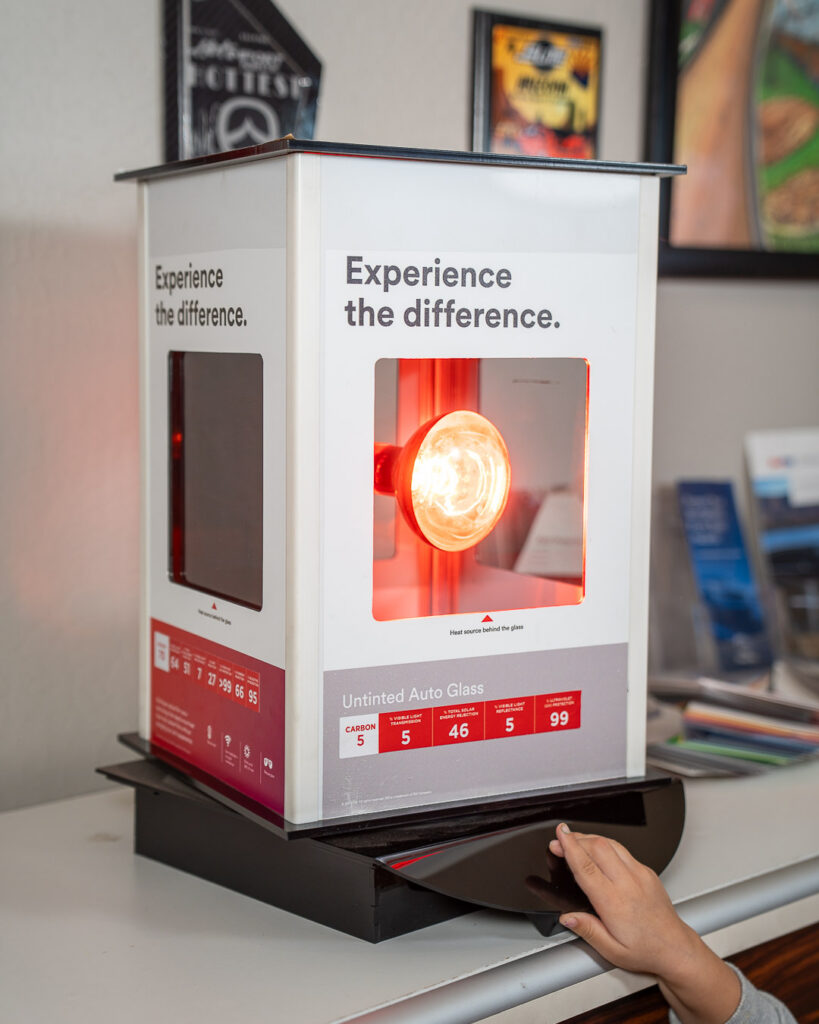
The display is a demonstration under those conditions, not a prediction of your vehicle’s temperature. We use it alongside the manufacturer specifications and a conversation about how you use the vehicle. If Carbon does what you need, we’re happy to install Carbon.
Carbon and ceramic tint questions
Do I need ceramic tint for UV protection?
No. SunTek’s specification sheet lists greater than 99% UV protection across its Carbon range in the tested 300–380 nm wavelength range. You don’t have to choose ceramic solely to get that benefit. Check the exact product and shade; our UV protection guide explains how UV, heat and darkness differ.
Is ceramic tint darker than Carbon?
Not automatically. Both come in different shades. Choose the film for its performance and the shade for the amount of visible light you want passing through, while considering visibility and the requirements for each window. The existing glass also affects the finished result.
My truck or SUV already has dark rear glass. Does that change the comparison?
Yes. Factory privacy glass is part of the starting point, and its solar and UV performance varies by vehicle and glass type. Darkness alone doesn’t tell us what it blocks. We’ll look at the existing glass, check for any applied film and help you compare options without assuming you need to make it much darker.
Does ceramic automatically come with a better warranty?
No. SunTek backs Carbon, CXP, CeramicIR and Evolve with manufacturer’s lifetime limited warranties, subject to the applicable terms and restrictions. Compare the actual warranty coverage rather than assuming the word “ceramic” means a longer warranty.
What would you like your tint to do better?
Tell us about your vehicle, the windows you want tinted and what matters most to you. We’ll help you compare the options and provide pricing. You don’t need to choose a film before contacting us.