
Window Tinting FAQs
Window tint can get technical pretty quickly.
These are answers to the questions we hear from customers, installers and people trying to understand how window film actually works—from tint percentages and heat rejection to installation techniques, warranties and tint laws.
We’ve been working with window film for years, so when there’s a simple answer, we’ll give you the simple answer. When the real answer is “it depends,” we’ll explain what it depends on.
Answered by Danny — owner, installer and window film nerd at Aladdins Window Tinting.
What Do You Want to Know About?
Jump to the topic you’re interested in, or browse the full page to get a better understanding of how window tint works, how it’s installed and what to expect before and after the job.
Window Tint Percentages & VLT
What does VLT mean in window tint?
VLT stands for Visible Light Transmission. It is the percentage of visible light that passes through the glass and film.
A higher VLT number means more visible light gets through, so the tint looks lighter. A lower VLT number allows less visible light through and looks darker.
One important detail: the VLT printed on the film is not necessarily the final VLT once that film is installed on automotive glass. The glass already reduces some light on its own, so the combined glass-and-film reading will usually be lower than the film’s labeled shade.
Does darker window tint block more heat?
Not necessarily.
Tint darkness and heat-rejection performance are two different things. A darker film can reduce more visible light and glare, but a lighter high-performance film may reject more solar energy than a darker entry-level film.
That is why choosing window tint based only on the shade percentage can be misleading. The film construction and its actual performance specifications matter too.
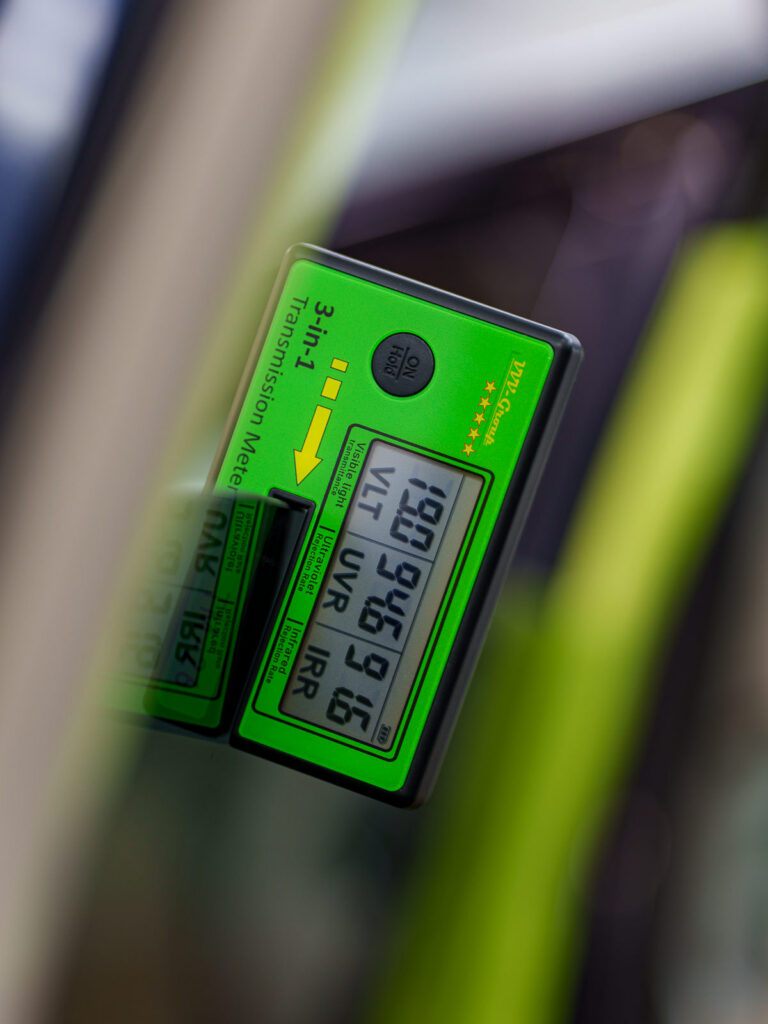
Why doesn’t my tint meter read the same percentage as the film I selected?
Because the meter is reading the glass and film together.
Automotive glass already has its own visible-light transmission before any film is installed. When tint is added, the final reading reflects the combined effect of both materials.
That is why a film labeled 35%, 55% or 70% will usually meter lower once it is installed on an actual vehicle window.
Heat Rejection, Infrared & UV
What is the difference between infrared (IR) and ultraviolet (UV)?
Infrared and ultraviolet are different parts of the solar spectrum, and they should not be treated as the same performance measurement.
Infrared radiation contributes to the radiant energy you feel as heat. Ultraviolet radiation is associated with skin exposure and contributes to fading and deterioration of vehicle interiors.
A film’s IR-rejection number can be useful when comparing products, but it does not tell the entire heat-rejection story by itself. Total Solar Energy Rejected (TSER) looks at a broader portion of the solar spectrum and is an important measurement when evaluating overall solar performance.
Does window tint block UV even if the tint is light?
Yes, depending on the film.
UV protection and tint darkness are separate characteristics. A window film does not have to look dark to provide strong UV protection.
This is one reason it is important to compare film specifications rather than assuming that the darkest film automatically provides the best protection or performance.
Is infrared rejection the same thing as heat rejection?
No.
Infrared rejection measures performance within a particular infrared wavelength range. Heat inside a vehicle is influenced by more than infrared energy alone.
That is why an IR number should be considered alongside measurements such as Total Solar Energy Rejected (TSER), visible-light transmission and the actual testing method used by the manufacturer.
Window Tint Laws
Window tint laws vary by state and country, so legal questions always need some location context. Because our shop is in Arizona, we can answer Arizona-specific questions directly and point readers elsewhere to their local law when needed.
What is the legal limit for front side windows in Arizona?
Arizona law measures the window glass and applied material together.
For the front side windows, Arizona Revised Statutes §28-959.01 specifies a light transmission of 33% plus or minus 3%, along with a luminous-reflectance limit of 35% plus or minus 3%.
That combined-glass requirement matters because the shade printed on the film is not necessarily the number the completed window will meter after installation.
Tint laws can change, so we recommend checking the current Arizona statute when legality is the deciding factor.
Window Tint Installation & Finish
What is micro-edging?
Micro-edging is our standard finish on normal framed roll-down door windows.
It means keeping the small gap between the top edge of the film and the top edge of the glass as tight, straight and consistent as possible. That small gap is intentional, but a good micro-edge keeps it clean and unobtrusive for a factory-style finish.
What is the difference between micro-edging and filed edges?
Micro-edging leaves a very small, controlled gap and is our standard finish on normal framed door windows.
A filed edge is an upgraded finishing method where the film is installed to the edge of the glass and carefully filed for an essentially gap-free appearance.
Filed edges require additional installation time, are an extra-charge option and are most commonly used on suitable frameless door glass where the exposed edge is more noticeable.
Window Tint Warranties
What kind of warranty do I receive with window tint?
Warranty coverage depends on the film product and the manufacturer’s current terms.
The SunTek automotive film lines we currently install are backed by manufacturer limited warranties, and several of the lines we offer carry manufacturer lifetime limited coverage against specified defects such as peeling, cracking, adhesive failure, delamination and color change.
We provide the applicable warranty information for the product installed on your vehicle so you know exactly what is covered.
Is my window tint warranty transferable?
Do not assume a window-film warranty transfers automatically when a vehicle is sold.
Transferability depends on the manufacturer, film product and the warranty terms in effect for that installation. If transferability is important to you, ask us and we will confirm the current terms for the specific film before you purchase it.
Appointments & Visiting Our Shop
Do I need an appointment?
Appointments are recommended, but same-day appointments are welcome when our schedule allows.
If you’re planning ahead, start with our Get Pricing & Schedule page to choose the service you need and the appropriate next step.
If you are hoping to come in the same day, give us a call first. That lets us confirm availability and helps avoid making you wait longer than necessary.
Can I see and compare the different window films before I choose?
Absolutely.
If the numbers on a pricing sheet are not enough to help you decide, come into the shop and compare the films in person. We can show you the different shades, explain how the product lines are constructed and let you feel the difference on our heat display.
We would rather help you understand what you are buying than have you spend more money simply because one option has a higher price.
Can I wait while my vehicle is being tinted?
Yes.
Many automotive tint installations take around two hours, depending on the vehicle and the work being completed. You are welcome to wait in our Peoria shop, where we have a customer lounge with snacks, drinks and video games, or you can drop the vehicle off and come back when it is ready.
Do you offer mobile automotive window tinting?
No. Automotive window tinting is completed at our Peoria shop.
A controlled installation environment helps us manage dust, lighting, temperature and the other conditions that affect installation quality.
Residential and commercial window film is different—we travel to the property for those projects and offer free on-site estimates.
After Your Window Tint Is Installed
What should I do if I notice something after my tint installation?
Give us a call.
Freshly installed window film can look different while moisture is still drying, so not everything you notice immediately after installation means there is a problem.
If something does not look right or you are unsure whether what you are seeing is normal, send us a photo or bring the vehicle by the shop. We would rather look at it and give you a clear answer than have you wondering about it.
Still Have a Question About Your Vehicle?
If you are trying to choose a film, figure out the right shade or understand what makes sense for your vehicle, give us a call or send us the vehicle information. We are happy to talk through it with you.