
Updated October 19, 2026
“What’s the darkest legal tint?” sounds like it should have a one-number answer.
It depends on the window, the vehicle and the rules that apply. And before that number means much, you need to know what it measures. A film’s shade name and a reading through your finished window are not automatically the same thing.
This guide explains those differences, shows you how to check your state’s requirements, and uses Arizona as a practical example. The goal is to help you ask better questions before buying film.
Start here: A lower VLT percentage means less visible light passes through. Check the rule for each window and your vehicle type, confirm whether it concerns the finished glass-and-film combination, and verify any windshield, reflectance, color, mirror or exemption conditions. A shade number alone cannot establish compliance.
This is an educational explanation, not an individual legal determination. Official requirements and their effective dates control.
Jump to a section
- What tint percentages mean
- What a meter actually measures
- How to check your state
- State rules and federal requirements
- Arizona: the questions we hear
- Tint legality and warranty coverage
- Questions to ask before installation
What does VLT mean?
VLT stands for visible light transmission: how much visible light passes through the material being measured. Higher numbers mean more light gets through; lower numbers mean less.
| VLT | Plain-language meaning |
|---|---|
| 70% | About 70 out of every 100 units of visible light pass through. |
| 35% | About 35 out of every 100 pass through. |
| 5% | About 5 out of every 100 pass through. |
So 5% is substantially darker than 35%. It does not mean the film blocks only 5% of visible light.
VLT is also not a heat-rejection rating. If you want to compare comfort or solar performance, ask for the appropriate product specifications. This article uses VLT to discuss visible light and legal limits.
Terminology: International Window Film Association: VLT and visible light reflectance.
The film label is not your finished-window reading
The meter sees what is in its light path. With film installed on a window, that includes the glass and the film together.
Before you compare a product specification with a legal limit, check how that specification was determined. Is it for film alone, or film applied to a particular reference glass? An advertised shade is not a measurement of your vehicle.
Here is a simplified illustration, not a result from our shop: if glass transmits 80% of visible light and a separate film transmits 50%, multiplying 0.80 by 0.50 gives an estimated combined transmission of 40%. That illustrates why the finished result can be below the film-alone number. It is not a substitute for measurement, and you should not apply the calculation again to a specification already measured on glass.
Our same-window demonstration
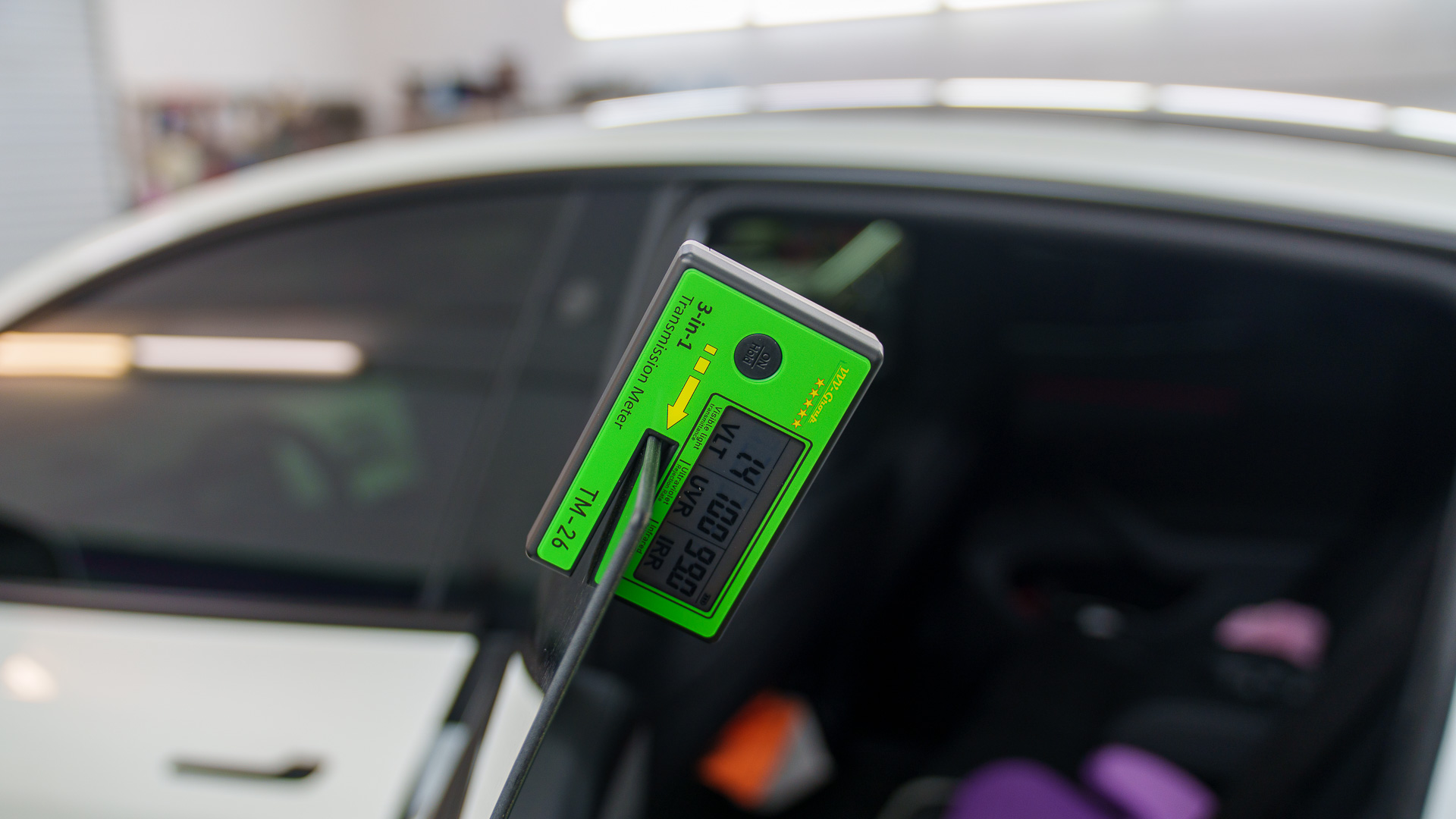
At Aladdins, we use a TM-26 for roll-down windows and a Laser Labs Model 400 for fixed-glass VLT measurements. The Model 400 uses separate components on opposite sides of the glass. In this demonstration, we are comparing visible light transmission, not proving heat rejection or certifying legal compliance.
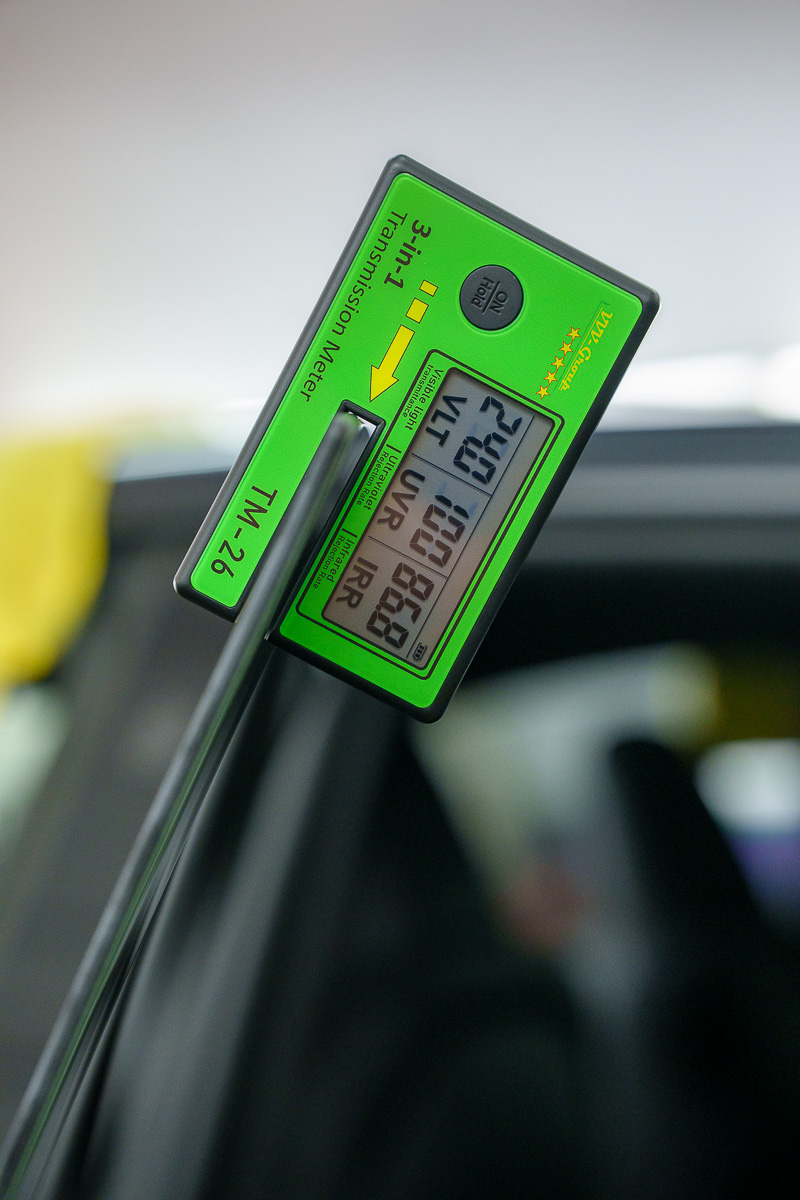
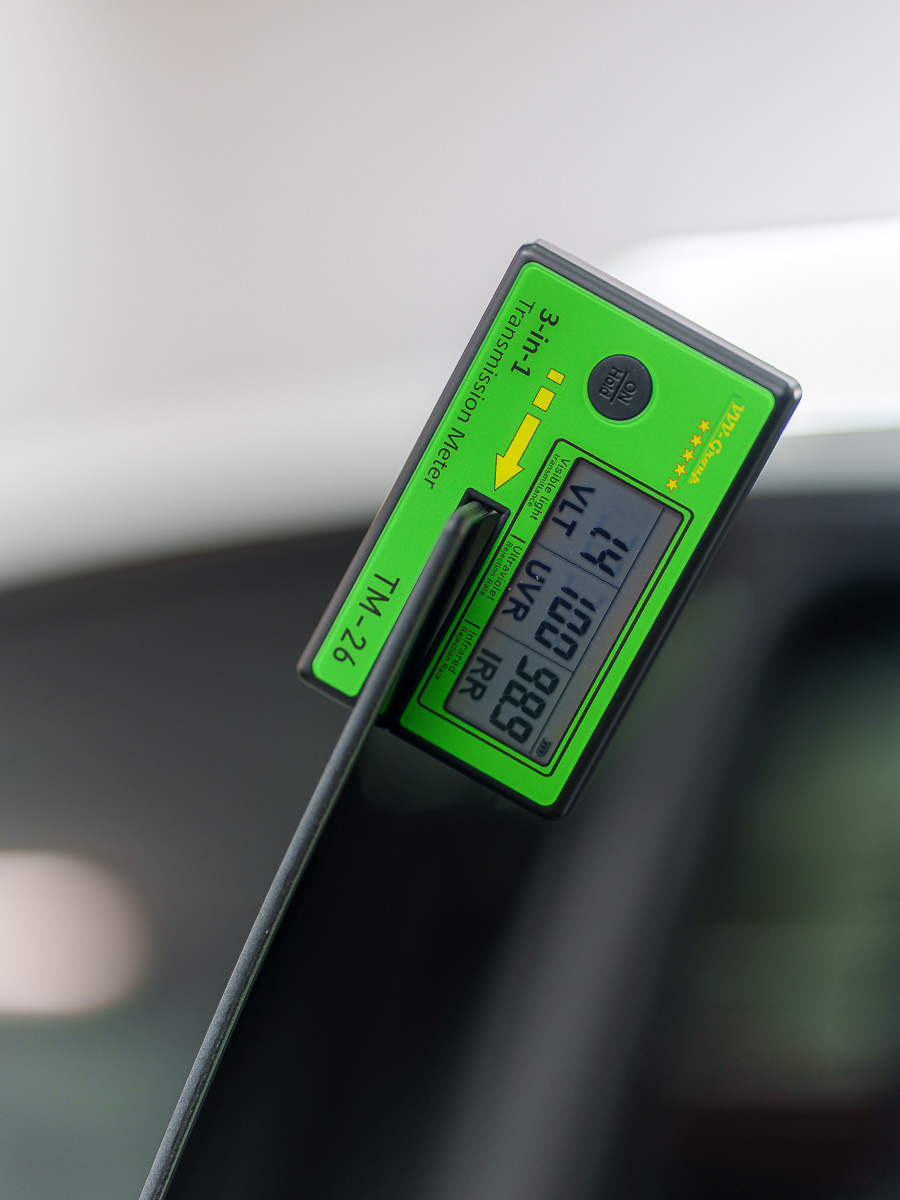
On this 2026 Tesla Model Y, the laminated rear door privacy glass measured 24.0% visible light transmission before we added film. After installing SunTek Evolve 5, the same window measured 1.4% VLT.
The takeaway: a film labeled 5% does not necessarily produce a finished window measuring 5%. The existing glass affects the result, which is why the installed combination needs to be measured.
Equipment reference: Laser Labs Model 400 description and specifications.
How to check your state’s window tint laws
Use a chart to orient yourself, then follow the requirements back to an official source.
- Choose the right state and vehicle category. Do not assume a sedan and an SUV have identical rules. The IWFA interactive lookup separates cars from multipurpose vehicles.
- Read each window separately. Front side windows, rear side windows, rear glass and the windshield may be treated differently.
- Check what the percentage describes. Look for language about glass, glazing, combined transmission or applied material. Ask how the finished window will be assessed.
- Read the conditions attached to the number. Look for reflectance, prohibited colors, strip placement, mirror requirements, labels and exemptions.
- Verify the current official requirement. Use the statute and the responsible motor-vehicle, public-safety or inspection agency. If they appear inconsistent, ask that agency to clarify before relying on a summary.
Where to find a reliable starting point
- IWFA interactive state lookup — industry summary; verify the applicable official rule.
- USAGov state motor-vehicle agency directory — official agency contacts for states and territories; this is a contact directory, not a tint-law chart. The agency can direct you to the office responsible for tint requirements.
- Arizona: A.R.S. § 28-959.01 — statute used for the Arizona explanation below.
- New York DMV: Tinted Windows — an example of official guidance that distinguishes vehicle categories.
- Texas DPS: Window Tinting Standards — an example of window-specific guidance and a link to the governing rule.
For example, New York’s DMV identifies rear-side-window requirements using the vehicle’s “Passenger Car” classification label. That is the kind of detail a single percentage in a search result can leave out.
If you are moving or taking the vehicle across state lines, ask the relevant authority about your situation. Do not assume your home-state installation or exemption answers every question elsewhere.
State driving rules and federal installation requirements are different questions
State tint charts are not the whole legal framework.
NHTSA’s published interpretation explains that federal glazing requirements and the prohibition on making compliant safety equipment inoperative can restrict work performed by manufacturers, distributors, dealers and repair businesses. It distinguishes those businesses from owners modifying their own vehicles, and from state regulation of vehicle use.
That distinction matters: permission to operate a vehicle under a state rule should not automatically be described as permission for every business to perform the installation. Federal requirements also depend on the glazing and vehicle involved.
Primary reference: NHTSA Interpretation 17440.drn, June 22, 1998. This is historical agency guidance explaining the distinction; it is not a new 2026 ruling or an individual compliance determination.
Arizona tint questions we hear at the shop
Rear-window darkness, windshields and visor strips cause the most confusion in our customer conversations. We also occasionally receive questions about colored or reflective film.
The following summarizes A.R.S. § 28-959.01; read its conditions together:
- Front sides: The statute specifies 33% light transmission, with a ±3-percentage-point tolerance, for the material and glazing together. It also specifies reflectance. A “35” shade label alone proves neither.
- Rear glass: There is no stated minimum VLT for the rear-window exceptions; reflectance and mirror provisions still matter. “No minimum VLT” is more accurate than “no restrictions.”
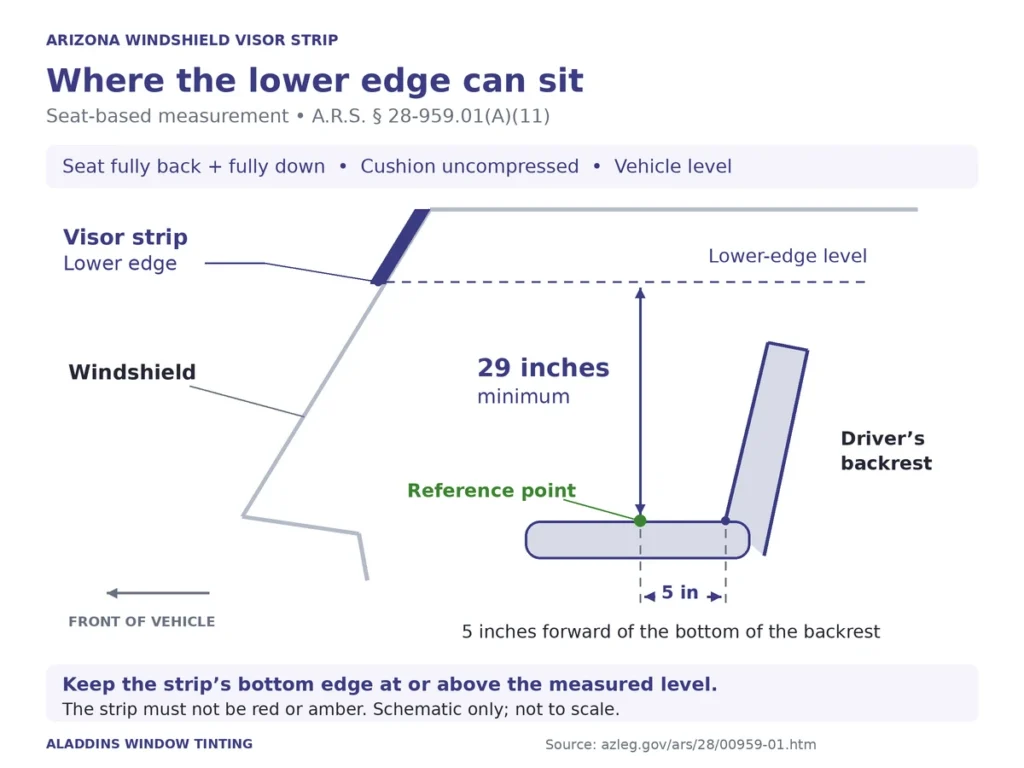
- Visor strips: Arizona uses a seat-based measurement, rather than simply the AS1 mark: the lower edge must be at least 29 inches above the uncompressed driver’s seat, measured five inches ahead of the backrest bottom, with the seat fully rearward and lowered and the vehicle level. Red and amber are prohibited for that strip.
- Full windshields: The top-strip exception does not authorize full-windshield darkening. A light-looking or ceramic film is not automatically permitted.
Check reflectance separately: the statute specifies 35% ±3 for front sides, and 35% ±3 or less behind the driver. Our fixed-glass VLT meter does not establish reflectance. Do not generalize the strip’s color rule to every window.
What about a medical exemption?
Arizona’s MVD provides an application process requiring medical certification. Follow its current instructions and obtain the required approval and certificate. A medical need alone should not be treated as completed authorization. Confirm which windows and modifications an exemption actually covers; do not assume it grants blanket permission for windshield tint.
Official instructions: ADOT Medical Review: window tinting exemption.
Tint legality and warranty coverage
The legal question and the warranty question both deserve an answer before installation.
Aladdins’ policy is that installations darker than legal limits do not receive a manufacturer’s warranty. SunTek’s own terms are separate: its June 2025 automotive limited warranty requires installation in accordance with applicable law and excludes illegal application or use, subject to its stated applicable-law qualification.
For Evolve, CIR, CXP and Carbon, the form describes lifetime limited coverage for specified manufacturing or material defects, including color change, peeling, cracking, adhesive failure and delamination. Coverage is for the original vehicle owner at installation and is not transferable. It is not a promise that every problem is covered.
Keep the completed warranty card and proof of purchase, and read the exclusions. A purchase receipt documents a transaction; it does not establish legal compliance or guarantee warranty approval.
Read SunTek’s automotive limited warranty.
What to ask before choosing your tint
- Which rule applies to this vehicle and each window?
- Does the specification describe film alone or film on reference glass?
- What is the glass reading before installation, and how will the finished window be checked?
- Are there separate reflectance, color, visor-strip, mirror or label requirements?
- If an exemption is involved, what approval and documents are required?
- Which written warranty terms apply to the proposed installation?
Bring the film choice, the vehicle and the actual requirements into the same conversation. That is much more useful than choosing a shade first and hoping the legal details work themselves out.
When UV exposure is the concern, our guide explains how existing vehicle glass and window film affect UV protection.
Need help choosing film for your vehicle?
We install automotive window film at our Peoria, Arizona shop. Bring your questions about shades, film options and the measurements behind them. We can explain your choices before you decide.